
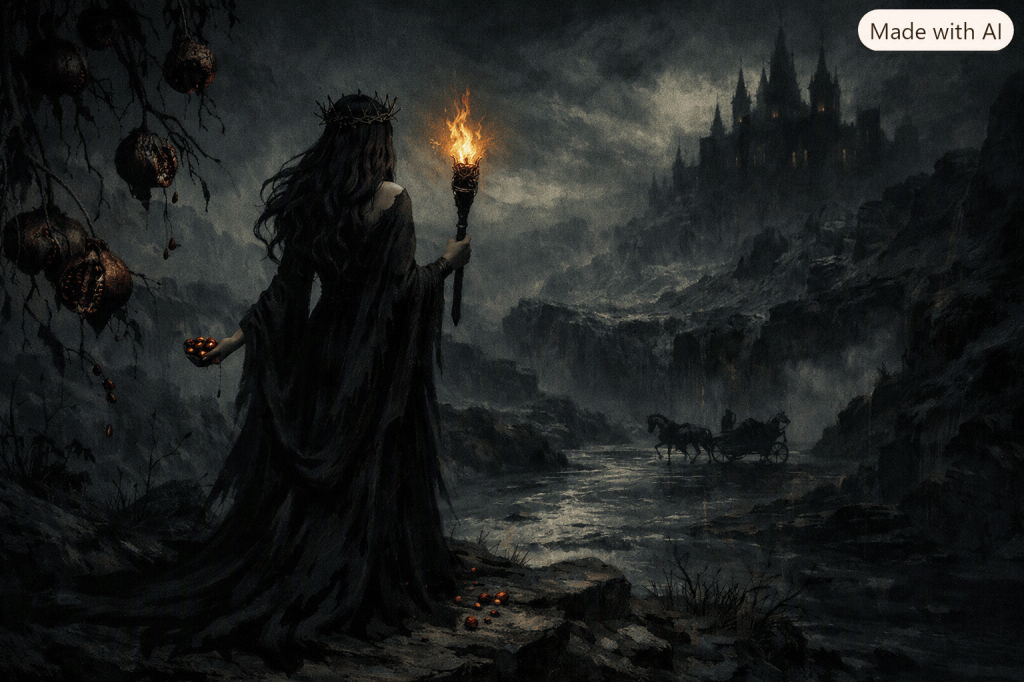
In Greek mythology the story begins long before the pomegranate.
Persephone was the daughter of Demeter, the goddess who made the earth bloom and fed humanity through her power over harvest and growth. One day, while Persephone was gathering flowers in a sunlit meadow, the ground split open beneath her feet. From that crack rose Hades, the god of the underworld. He seized her and carried her into the shadows below. Her cry echoed across the world, but no one reached her in time.
Demeter searched for her daughter with burning torches. She wandered the earth in grief so deep that crops refused to grow. Famine spread. The world dimmed. Even the gods felt the consequences of her sorrow.
Zeus finally intervened and sent Hermes to retrieve Persephone. Hades agreed to let her go, but before she left, he offered her a pomegranate. A small, gleaming fruit. A gesture that looked gentle and almost tender.
But the underworld has rules. Anyone who tastes its food becomes bound to it.
Persephone ate the seeds, and her fate was sealed.
The Persephone myth begins with a moment that feels almost innocent, a pomegranate offered in the stillness of the underworld.
Not a grand act of violence, not a thunderous shift in fate, but a small, deliberate gesture that sealed her life with a sweetness she never asked for.
A bite that tasted harmless, yet carried the quiet cruelty of a future she could never outrun.
Her tragedy isn’t only in being taken, it’s in being claimed.
Bound by a fruit she didn’t understand, tied to a darkness she never chose.
She gets her brief seasons of sunlight, yes, but they are borrowed. Temporary.
Every bloom she touches already knows she will leave it behind.
Every warm day is a countdown.
Every return to her mother is shadowed by the knowledge that she will be pulled back underground, back to Hades, back to the life that waits for her like a sentence.
And I think about how many people live like that.
Not in myth.
In marriages.
Some people eat their own version of the pomegranate without realizing it.
A promise made in a moment of fear.
A compromise that felt small but carried teeth.
A decision made because silence was easier than truth.
And suddenly, they’re tied to a life that feels colder every year.
A house where the air never warms.
A partner who becomes a weight instead of a refuge.
They get moments of escape, a night with friends, a quiet walk alone, a fleeting reminder of who they once were.
But like Persephone, they can’t stay in the world that feels like theirs.
There is always something dragging them back: duty, guilt, culture, the fear of being judged, the fear of being alone, the fear of breaking everything just to save themselves.
It doesn’t always look dramatic from the outside.
Sometimes it’s just a slow dimming, a person fading in plain sight.
People imagine the underworld as a place of torment, but myths rarely shout.
Hades wasn’t monstrous.
He was steady.
Predictable.
A presence that didn’t change and that’s its own kind of prison.
Some marriages feel like that.
Not violent, not catastrophic, just… heavy.
A life that is easier to endure than to escape.
A routine that becomes a quiet suffocation disguised as stability.
You learn to navigate the shadows.
You learn to keep your voice low.
You learn to carry your own torch the way Demeter did, searching for pieces of yourself in places where you never should have had to look.
Persephone’s tragedy isn’t that she lives in the underworld.
It’s that she lives between worlds.
Never fully alive in the light.
Never fully dead in the dark.
Never entirely herself anywhere.
And that’s the quiet heartbreak of being stuck in a marriage you cannot leave:
you become a seasonal version of yourself.
A person who blooms only in stolen moments.
A person who learns to ration their hope.
You get glimpses of who you could be, but you can’t stay long enough to become her.
Persephone didn’t stay the maiden forever.
She became a queen.
Not because she wanted the underworld, but because she learned to claim power inside a life she didn’t choose.
And maybe that’s the part of the story that matters for anyone who feels bound by their own pomegranate seeds:
you may not be able to leave yet,
you may not be able to rewrite everything,
but you can still reclaim pieces of yourself.
You can still rise in the places that tried to bury you.
You can still become something stronger than the fate you were handed.
